
2026-08-20 · Mike Landry
Installing EV Charger Circuits for Spanish Fort Commuters
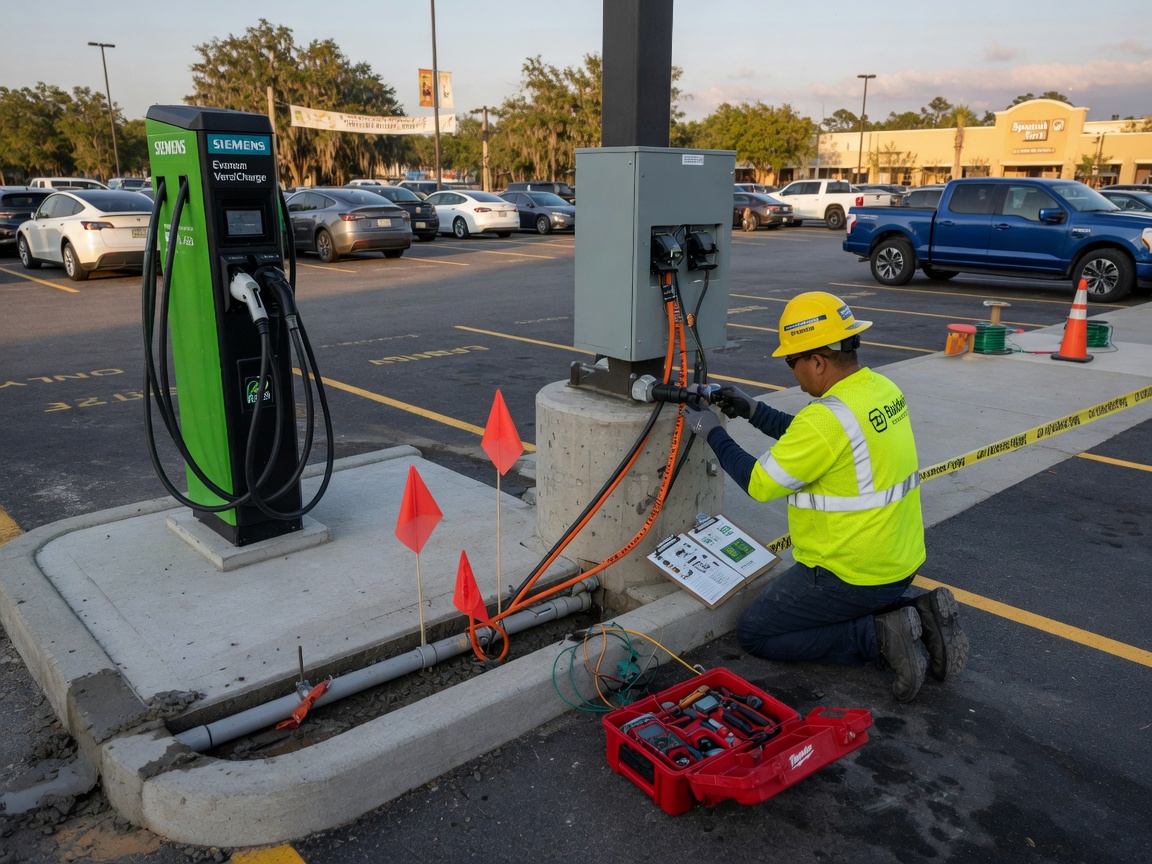
Spanish Fort homeowners commuting daily to Mobile or Daphne typically install a dedicated 40-amp or 50-amp 240-volt circuit that supports Level 2 charging without overloading existing wiring. The work starts with a load calculation on the main panel, followed by running appropriate gauge wire through attics or exterior walls to a garage or carport location near the driveway.
Evaluating Panel Capacity in Spanish Fort Homes
Many homes in Spanish Fort Town Center and Malbis neighborhoods were built in the 1990s and early 2000s with 150-amp or 200-amp panels that already serve air conditioning, electric water heaters, and pool equipment. Adding an EV charger often requires checking available breaker space and verifying the service entrance rating before any new wiring begins. Older properties near Historic Blakeley State Park sometimes carry fuse boxes or early breaker panels that cannot safely handle the continuous load of a charger. In those cases the upgrade path includes replacing the panel and possibly the meter base to maintain proper clearance and grounding. Commuters who drive 30 to 50 miles round-trip each day benefit from confirming at least 30 to 40 amps of headroom remains after all other major loads are accounted for.
Routing Circuits Through Local Housing Stock
Spanish Fort construction often features raised crawl spaces or slab-on-grade foundations with limited access points. Running wire from the panel to an exterior charger location may require fishing through attic insulation or along exterior soffits while avoiding HVAC ducts common in Baldwin County homes. Salt air from Mobile Bay accelerates corrosion on any exposed metal fittings, so stainless steel or coated junction boxes are used on outdoor runs. Homeowners in Malbis frequently request the charger outlet mounted on the side of the garage facing the driveway to shorten the cable length to the vehicle. Proper support of the wiring every 4 feet and use of conduit where it exits the structure prevents damage from lawn equipment and coastal winds.
Accounting for Humid Subtropical Conditions
The region's hot summers and mild winters with high humidity mean outdoor wiring must resist moisture intrusion year-round. Protecting Outdoor Wiring from Salt Air Corrosion Near Mobile Bay explains the specific fittings and sealants that hold up best in this environment. GFCI protection is required for all outdoor receptacles, and the charger itself should carry a NEMA 4 or 4X rating to keep internal components dry during heavy summer rains. Installers also leave extra slack in the cable to accommodate minor ground settling common on lots near the Eastern Shore.
Connecting the Charger to Daily Commutes
A properly sized circuit lets Spanish Fort residents charge overnight and arrive at work in Mobile or Daphne with a full battery without relying on public stations. EV Charger Installation covers the final connection steps once the circuit is in place. Drivers who travel longer distances on weekends often choose a 50-amp circuit paired with a 40-amp continuous-rated charger to recover 25 to 30 miles of range per hour. Placement of the unit at waist height near the driver's door reduces tripping hazards and keeps the cord off the ground where it could collect standing water after coastal storms.
Coordinating with Panel Upgrades When Needed
When the existing panel lacks capacity, Electrical Panel Upgrades become the first step before any charger circuit is added. The upgrade typically includes a new 200-amp or 225-amp panel with additional breaker spaces and updated grounding to meet current Baldwin County requirements. This work is scheduled during business hours at 8591 Wimbledon Ct, Spanish Fort, AL 36527 so homeowners can plan around their commute. After the panel is replaced, the new EV circuit is installed as one of the first new breakers, ensuring the charger receives clean power without competing with other high-draw appliances.